Heart and metabolic risk, read early
Know before it’s urgent.
A preventive health check in Colombo for anyone with heart disease or diabetes in the family, or a ‘normal’ report and no plan. Within about two weeks of the draw, one physician tells you where you stand and what to change first.
What you receive
One report, written by the physician who met you.
Not a laboratory printout. One physician reads every number together, against thresholds built for South Asian biology, and says plainly what needs attention, what does not, and what to do first.
- 0140 or 55 biomarkersAcross heart, metabolism, liver, kidneys, thyroid and blood, with vitamins and minerals on Premium, read as one picture rather than as isolated numbers.
- 02A heart-risk forecastFrom age 30, where your cardiovascular risk is heading, with the reasons, before any symptom.
- 03A named physicianEvery page reviewed, written and signed by one doctor, who then sits with you to go through it.

Three numbers no routine screening gives you
How old your biology reads, where your heart is heading, and how strong you are.
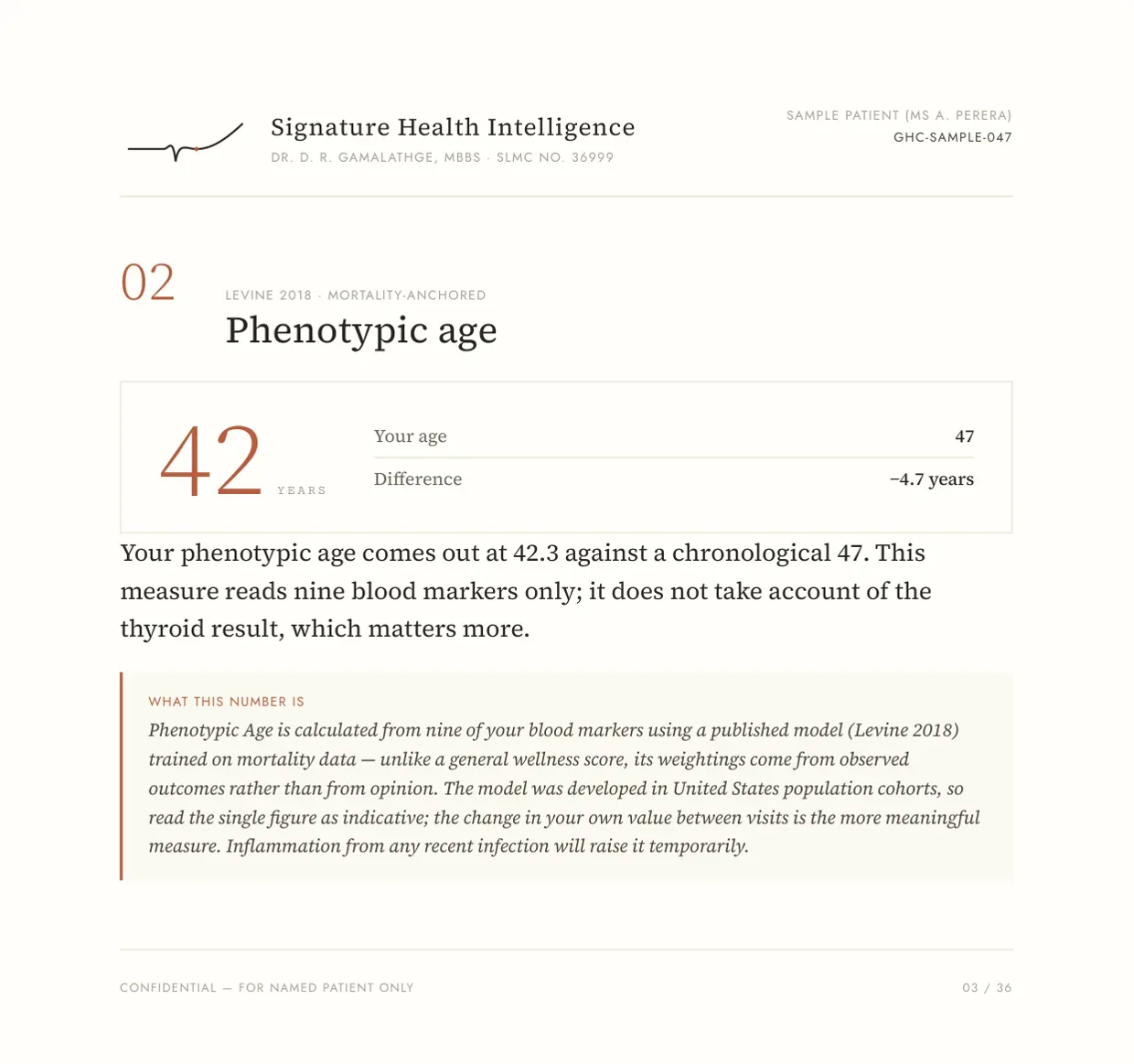
Phenotypic age
How old your body reads from nine blood markers in a published model, set beside your actual age. A rate, not a verdict: the model was built in US populations and has not been validated in South Asians, so what matters is whether it moves when the panel is repeated at the Year-2 renewal. Premium reports phenotypic age; Essential reports a metabolic age, a house score from its own markers, your waist-to-height ratio and your blood pressure.
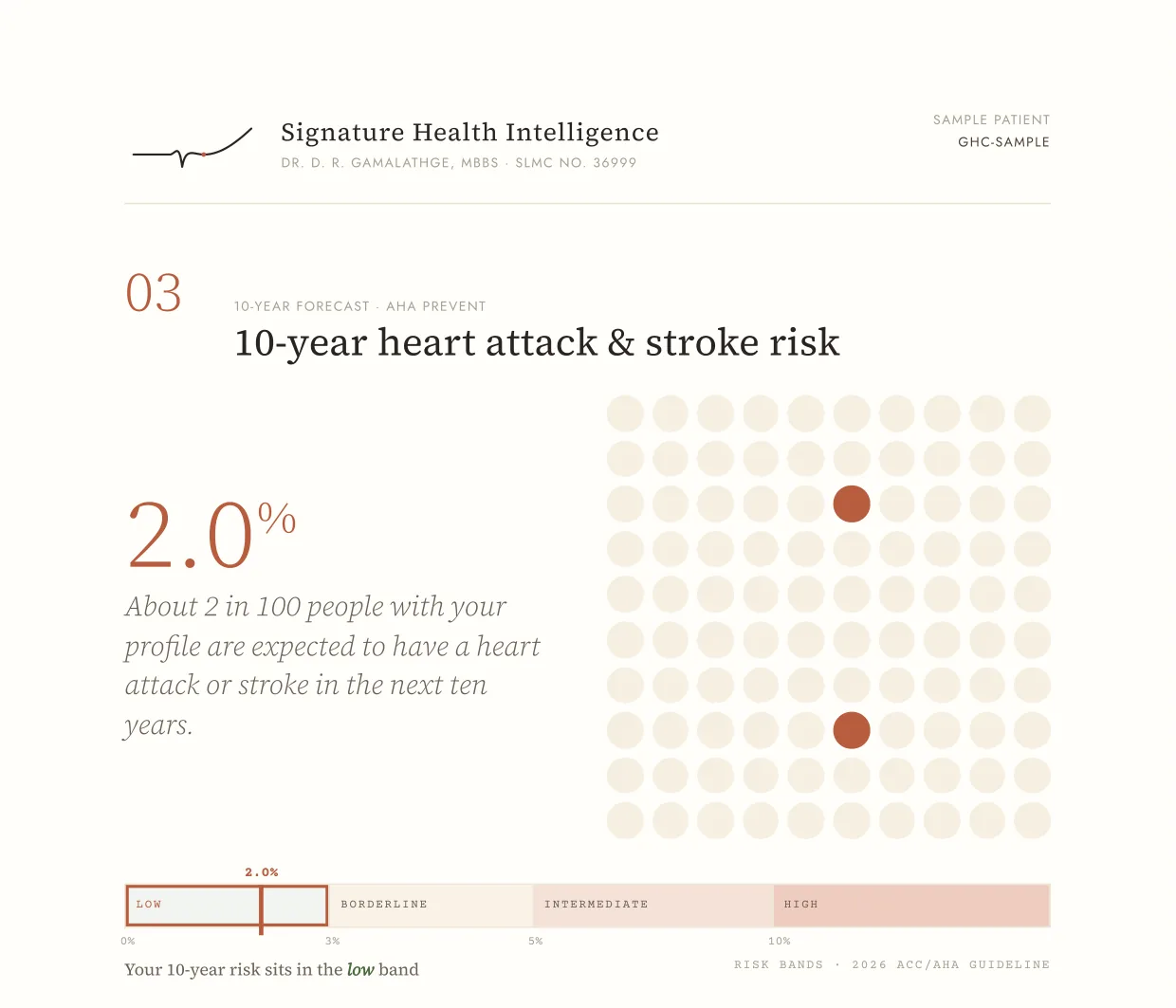
Ten-year cardiovascular risk
From 40, your chance of a heart attack or stroke in the next ten years on the AHA PREVENT equations, with the WHO 2019 South-East Asia chart shown beside it as a comparison up to 74, and the risks neither can see listed beneath. From 30 to 39 the report gives both a ten-year and a thirty-year view, because a decade understates a younger person’s risk; under 30 it tracks the direction of your numbers instead of a percentage.
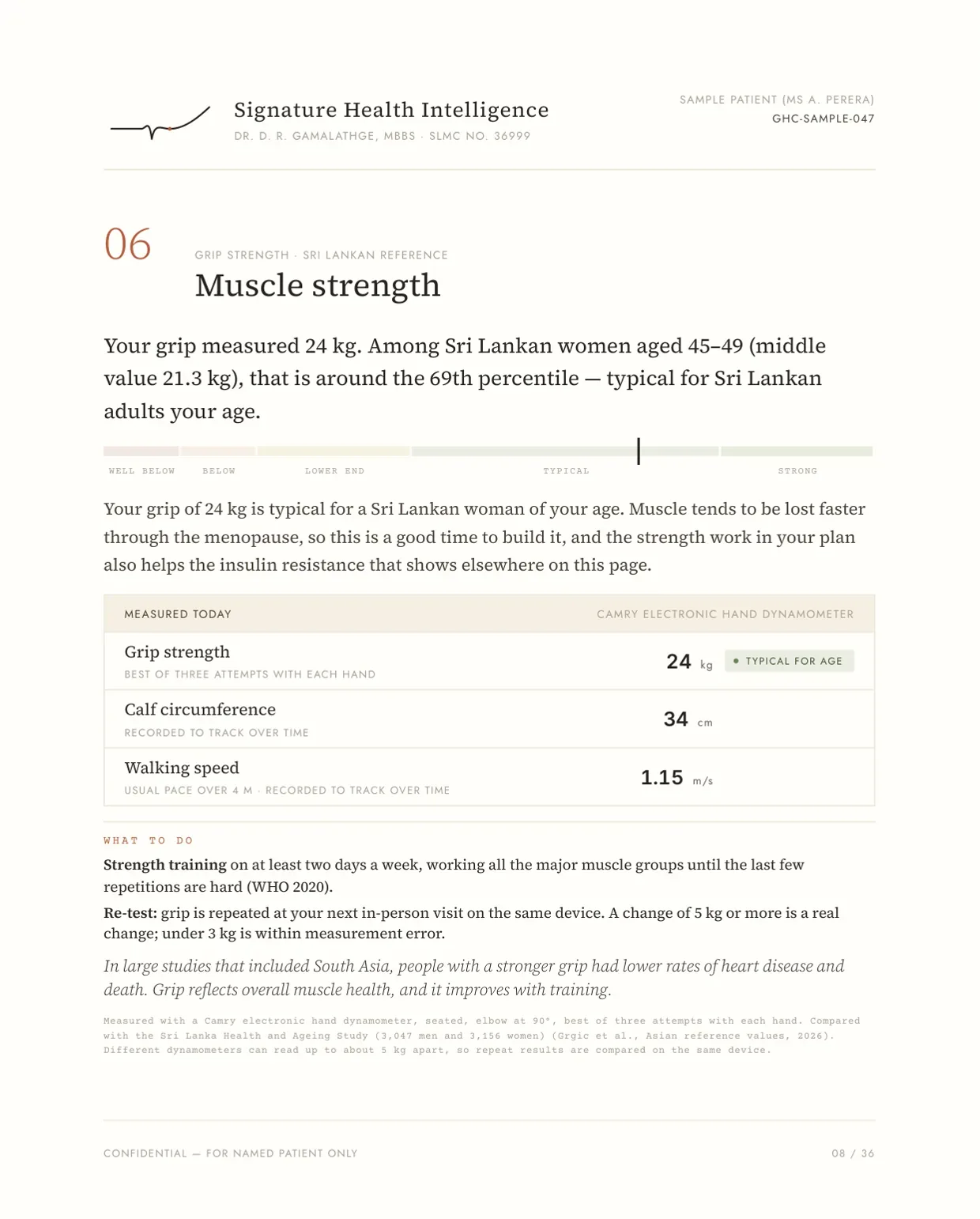
Grip strength
Measured at the consultation and read against published South Asian reference values for your age and sex. In large studies that included South Asia, a stronger grip went with lower rates of heart disease and death. It improves with training, and it is repeated on the same device at every in-person visit.
Programmes
Two programmes. The same care, a different depth.
Signature Health Intelligence runs two physician-led preventive health programmes in Mirihana, Nugegoda: 40 biomarkers on Essential (LKR 23,000 founding) or 55 on Premium (LKR 55,000 founding), with one in-person consultation, a written report and a targeted repeat at three months. Every programme starts with a phone call that costs nothing, and nothing is paid before it. Both include:
- A free first call
- A consultation in person
- Blood drawn at home, or at the centre
- A written report, and a consultation to go through it
- A targeted repeat at three months, and a report on what changed
- A list of the cancer screenings due for your age, and where to have them
Essential
For anyone whose last test was a fasting glucose and a cholesterol.
What it checks:Cholesterol and heart risk, blood sugar, liver, kidneys and electrolytes, thyroid, blood count, urine and a general inflammation marker.
What you learn:A heart-risk forecast from age 30, and a metabolic age: a simpler body-age score from routine markers, your waist and your blood pressure.
Report about 7 days after the draw.
Begin Essential Every Essential biomarkerPremium
For anyone with heart disease or diabetes in a parent or sibling, or who wants the numbers a routine screening does not order.
What it checks:Everything in Essential, plus a closer look at the heart (ApoB and a sensitive inflammation test), the full liver panel, early kidney damage, vitamin D, B12, calcium, magnesium and uric acid.
What you learn:A heart-risk forecast from age 30, and your phenotypic age: the fuller body-age reading shown above.
Report about 14 days after the draw.
Begin Premium Every Premium biomarkerThe prices shown are founding prices. The launch prices are LKR 55,000 (Essential) and LKR 90,000 (Premium).
Not sure which? Ask on the free call
Nothing is added without your agreement. If your history or examination gives a reason, the physician may suggest one of eight additions, such as a check for insulin resistance, iron stores or a bowel screening test, at LKR 4,500 to 12,900 each. A few follow-on tests run only if a first result calls for them, at laboratory cost. Everything is explained and priced first.
The additions, follow-on tests and their pricesPrices are confirmed on the first call, before anything is drawn. The Month-12 full repeat is the Year-2 renewal, purchased separately. Biomarkers are counted as individually reported laboratory values; the full list and the count are on the biomarkers page.
If a number is bad
What happens next.
A result that cannot wait is phoned the same day, and the referral letter goes the same day.
A result that needs treatment is written up with the threshold it crossed and the guideline behind it, discussed at the results consultation, and treated there.
A result that needs watching is repeated at Month 3, and the Delta report says whether it moved.
How it works
One appointment. Follow-up to Month 3, renewal at Month 12.
- Before anythingA free phone call
About 15 minutes: your history, your question, and which programme fits. No payment before this.
- Month 0Consultation and draw
Vitals, a resting ECG, examination and grip strength in person at Mirihana. Blood drawn at home, or at the centre.
- About 7 or 14 daysThe report
Written by the physician once every biomarker is in, then a results consultation to go through it.
- Month 1A check-in
A WhatsApp message to make sure the plan has started.
- Month 3Delta report
The biomarkers that can move, repeated and placed beside baseline. Included in both programmes.
- Month 12 · Year 2Full repeat, purchased separately
Not part of the first year. The whole panel again at the founding renewal price, LKR 35,000 on Essential or 65,000 on Premium, and a two-year trajectory. Clients who join at the launch price renew at LKR 49,500 (Essential) or 81,000 (Premium).
Why the thresholds are different here
A ‘normal’ range rules out disease today. It is not calibrated for South Asian biology.
South Asians meet cardiovascular events at lower numbers. The report reads your biomarkers against South Asian cut-offs, and against the direction they are moving, because the direction is what the programme tracks: the years lived in good health, not only the numbers today.
- 50%never tested
Half of Sri Lankan adults have never had their cholesterol measured, while 48.7% already have a raised level (5.0 mmol/L or above, or on treatment).
- 37.7%pre-diabetic
In Western Province (adults 20 and over, fieldwork 2018–20, adjusted for age and sex) more than a third of adults are pre-diabetic, and another 27.8% already have diabetes, most feeling well.
- 6×undiagnosed
Among adults in their thirties, undiagnosed high blood pressure outnumbers diagnosed cases roughly six to one.
- 13.6%of hospital deaths
Ischaemic heart disease was the leading cause of hospital deaths in 2022, 13.6% of all deaths in hospital.
Journal
Read before you decide.
Physician-authored notes on cardiovascular and metabolic risk, written for Sri Lanka, where the thresholds that matter are not always the ones printed on the report. All articles
Know your numbers: which routine checks guidelines suggest for you
Two minutes and no email. See which blood pressure, cholesterol and blood sugar checks guidelines suggest for adults like you, and where your BMI and waist sit against South Asian limits.
How to read a lipid profile report, line by line
What each line means, why LDL comes first, why the printed reference range is not your goal, and how to convert between mmol/L and mg/dL.
A healthy waist size for a South Asian body
The International Diabetes Federation sets South Asian waist limits at 90 cm for men and 80 cm for women. Half your height is the simpler rule, and how to measure it.
An HbA1c of 5.7 to 6.4: what pre-diabetes means
The top of the pre-diabetes range carries roughly double the risk of the bottom, lifestyle change has trial evidence behind it, and anaemia can make the number read wrong.
What fasting insulin and HOMA-IR show years before glucose does
Fasting glucose is the last number to move. In one cohort it stayed normal for a decade before diagnosis, while insulin sensitivity was already falling.
What ApoB measures, and why it is missing from most reports
Two identical LDL results can carry very different risk. ApoB counts the particles that build plaque; LDL only weighs the cholesterol they carry.
Cholesterol testing in Sri Lanka: half of adults have never had one
What a lipid profile measures, why a ‘normal’ result may not mean optimal for a South Asian body, and why total cholesterol is the least useful number on the page.
 Dr. D. R. Gamalathge
MBBS · SLMC No. 36999
Dr. Gamalathge Healthcare Centre, Mirihana
The physician
Every report reviewed personally.
Dr. Gamalathge is a physician with over a decade of clinical experience and the founder of Signature Health Intelligence, based at the Dr. Gamalathge Healthcare Centre, Mirihana, Nugegoda.
A special interest in preventive cardiology and metabolic health grew from a pattern that could not be ignored: cardiovascular and metabolic risk appearing in progressively younger people, in patients and in friends and family. Investigating only when symptoms appear was arriving too late.
Results mean nothing alone. The work is translating your biomarker data into a clinical conversation about your future, not just your present.Full profile
Questions
Asked before the first call
What does the report cover?
40 biomarkers on Essential and 55 on Premium, across lipids, metabolic markers, liver and kidney function, thyroid and the blood count, with minerals and vitamins on Premium, read together rather than as isolated numbers. Every report includes a cardiovascular forecast on the AHA PREVENT equations, ten-year for patients 40 and over and a ten- and thirty-year view from 30 to 39 (under 30, the direction of the biomarkers is tracked instead), a biological-age reading, and a clinical narrative written by the physician.
How is this different from a standard blood test?
Standard laboratory reports show numbers beside reference ranges that were not derived from South Asian populations. Here the results are read against South Asian thresholds, as one connected picture, and written up by a physician who has met you. You receive clinical meaning, not data.
Is this a full body check-up?
In part. It covers the blood and urine side of a full body check-up: 40 biomarkers on Essential across the heart, blood sugar, liver, kidneys, thyroid, blood count and urine, and 55 on Premium, which adds ApoB, hs-CRP, the full liver panel, early kidney damage, vitamins and minerals. The consultation adds a resting ECG and measurements including blood pressure, waist and grip strength. It does not include scans. What it adds is one physician who examines you, reads every result against South Asian thresholds and repeats what can change at three months.
Do I need to visit a clinic?
Blood can be drawn at home, office or hotel, or at the centre in Mirihana. The vitals assessment, a resting ECG, the examination and the grip strength measurement take place in person at the centre. Every patient attends one in-person appointment as part of the programme.
What is the Month-3 Delta report, and is it included?
A targeted repeat of the biomarkers that can move, placed beside the baseline, with a note on what changed and what to do next. It is included in both programmes at no extra cost. The Month-12 full repeat is not included; it is the Year-2 renewal, purchased separately.
How long does the report take?
Essential within about a week of the draw; Premium within about 14 days, because the physician waits for every result before writing one complete report. The results consultation is scheduled once the report is complete.
Is this suitable if I feel completely well?
Especially so. The programme is built to find metabolic and cardiovascular risk years before symptoms, which is when a change of direction is easiest and does the most for the years lived in good health.
How are the heart forecast and the body age calculated?
The cardiovascular forecast uses the AHA PREVENT equations: a ten-year figure from age 40, with the WHO 2019 South-East Asia risk chart shown beside it as a comparison from 40 to 74, and a ten- and thirty-year view from 30 to 39; under 30 the report tracks the direction of the biomarkers instead of a percentage. Phenotypic age on Premium is the published Levine 2018 model, built from nine blood markers; it was derived in US populations and has not been validated in South Asians, so the change between visits matters more than the single value. Metabolic age on Essential is an in-house score from HbA1c, fasting glucose, triglycerides, HDL, non-HDL cholesterol, ALT, eGFR, waist-to-height ratio and systolic blood pressure. It is not a published or validated model, so it is read for change between visits rather than as a single verdict.
Will I be asked to pay for extra tests?
Only with a reason and your agreement. The programmes cover 40 or 55 biomarkers. If your history or examination points to one of eight possible additions, the physician explains why and gives the price (the laboratory’s price plus LKR 500, between LKR 4,500 and 12,900), and it is confirmed in writing before the draw. Three follow-on tests (free T4, folate and SHBG) are run only if a first result calls for them, at laboratory cost, and only with your prior written agreement. The additions, the follow-on tests and their prices are listed on the biomarkers page.
Does the programme screen for cancer?
It covers the screenings that are due. The report lists the cancer screenings due for your age, sex and family history: bowel, cervical and breast, and for men aged 50 to 69 a conversation about PSA. A bowel screening stool test (LKR 5,000) and, after that conversation, a PSA test (LKR 8,000) can be added to the same draw; cervical and breast screening are referred to where they are done. Blood tumour markers such as CA-125, CEA or CA 19-9 are not used to screen people without symptoms; PSA is offered only after a conversation about what it can and cannot show.
Can I do this from abroad?
Yes. Diaspora patients visiting Sri Lanka schedule the review during their trip. Contact at least two weeks before arrival so that the draw and the report fit inside the visit.
Begin
Start with a call that costs nothing.
A short conversation about your history and your question, and which programme fits. The fastest way is a message.
Message on WhatsAppdimithra@signaturehealthintel.com
Dr. Gamalathge Healthcare Centre, Mirihana, Nugegoda